

Every gemstone tells a story — not just of geology, but of human meaning, emotion, and intention. Understanding gemstone meanings is one of the oldest practices in human history: from the fiery passion of a ruby to the serene calm of an aquamarine, the color of a stone has shaped how civilizations across history have understood the world around them.
In this ultimate guide to gemstone meanings by color, we cover everything: what gemstones actually are, how they get their colors, what each color means, and how to choose the right stone for you — by color, birthstone, or purpose.
Whether you’re a first-time buyer or a seasoned jewelry lover, this is your go-to reference.

What is a Gemstone?
A gemstone is a mineral, rock, or organic material that has been cut, polished, and deemed valuable — either for its beauty, rarity, durability, or cultural significance. While most gemstones are minerals formed deep within the Earth, some (like pearls and amber) come from biological processes.
The word ‘gemstone’ is broad, and it’s often used interchangeably with terms like crystal, jewel, and stone — but these words aren’t actually synonyms. Here’s how they differ:
Crystals vs. Gems

All gems can be crystals, but not all crystals are gems. A crystal is defined by its internal atomic structure — the way its molecules arrange themselves in repeating geometric patterns. Quartz, for example, is a crystal. When a crystal has sufficient beauty, rarity, and hardness to be used in jewelry, it crosses the threshold into being called a gem.
The key distinction: crystals are a geological classification; gems are a value classification.
Gems vs. Jewels
A jewel is a gemstone that has already been set into a piece of jewelry. So a sapphire sitting loose is a gem; the same sapphire set into a ring becomes a jewel. The word ‘jewel’ comes from the Old French jouel, originally meaning a plaything or ornament of great value.
In everyday language, ‘jewel’ and ‘gem’ are often used interchangeably — but technically, jewel implies the stone has been mounted and is ready to wear.
Stones vs. Gemstones
‘Stone’ is the most casual of these terms. Every gemstone is a stone, but not every stone is a gemstone. Rocks like granite or limestone are stones but not gemstones. The distinction is value: a gemstone must be considered precious or semi-precious, desirable enough to be cut and used in adornment.
Some people use ‘stone’ as a shorthand for gemstone in everyday speech — especially in the crystal healing community, where ‘healing stones’ are often technically gemstones.
Is a Pearl a Gem?

Yes — pearls are classified as gemstones, even though they’re not minerals. They’re organic gems, formed inside mollusks (usually oysters) when an irritant becomes coated in layers of nacre over time. Other organic gemstones include amber (fossilised tree resin) and coral.
Pearls are the birthstone for June and have been prized as gemstones for thousands of years — arguably longer than most mined stones. Their organic origin makes them unique, but their beauty and rarity firmly place them in the gemstone category.
Types of Gemstones
Not all gemstones are considered equal. The jewelry industry has long divided them into two tiers — though this classification is more traditional than scientific.
Precious Stones vs. Semi-Precious Stones
Historically, only four gemstones were considered ‘precious’: diamond, ruby, emerald, and sapphire. Every other gemstone — from amethyst to turquoise — was labelled ‘semi-precious.’
This distinction dates back centuries and was largely based on rarity and value at the time. Today, the terms are considered somewhat outdated. A fine alexandrite or tanzanite can command far higher prices than a low-quality ruby or emerald — yet they’re still technically ‘semi-precious.’
Most gemologists and modern jewelers prefer to simply describe stones by their individual qualities rather than using the precious/semi-precious binary. At MyJewelryCorner, we evaluate every stone on its own merits: color, clarity, cut, and character.
Worth knowing: ‘Precious’ doesn’t always mean ‘more valuable.’ A rare alexandrite or high-quality tanzanite can be worth significantly more than a common ruby.
Gemstone Properties
How Color is Formed in Gemstones

Color is the most immediately striking quality of any gemstone — and it comes from a surprisingly nuanced mix of chemistry and physics.
Most gemstone color comes from trace elements within the mineral’s crystal structure. For example:
- Chromium gives rubies their red and emeralds their green
- Iron and titanium combine to create the blue in sapphires
- Manganese produces the pink in rose quartz and morganite
- Copper creates the blue-green of turquoise and amazonite
Some stones get their color from structural phenomena rather than chemistry. Opals, for instance, display color through light diffraction — tiny silica spheres within the stone scatter light into a rainbow of hues. This is called play-of-color.
Color in gemstones can also be affected by heat treatment, irradiation, and coating — processes that are common in the industry and must be disclosed by ethical jewelers.
How Gemstones are Valued
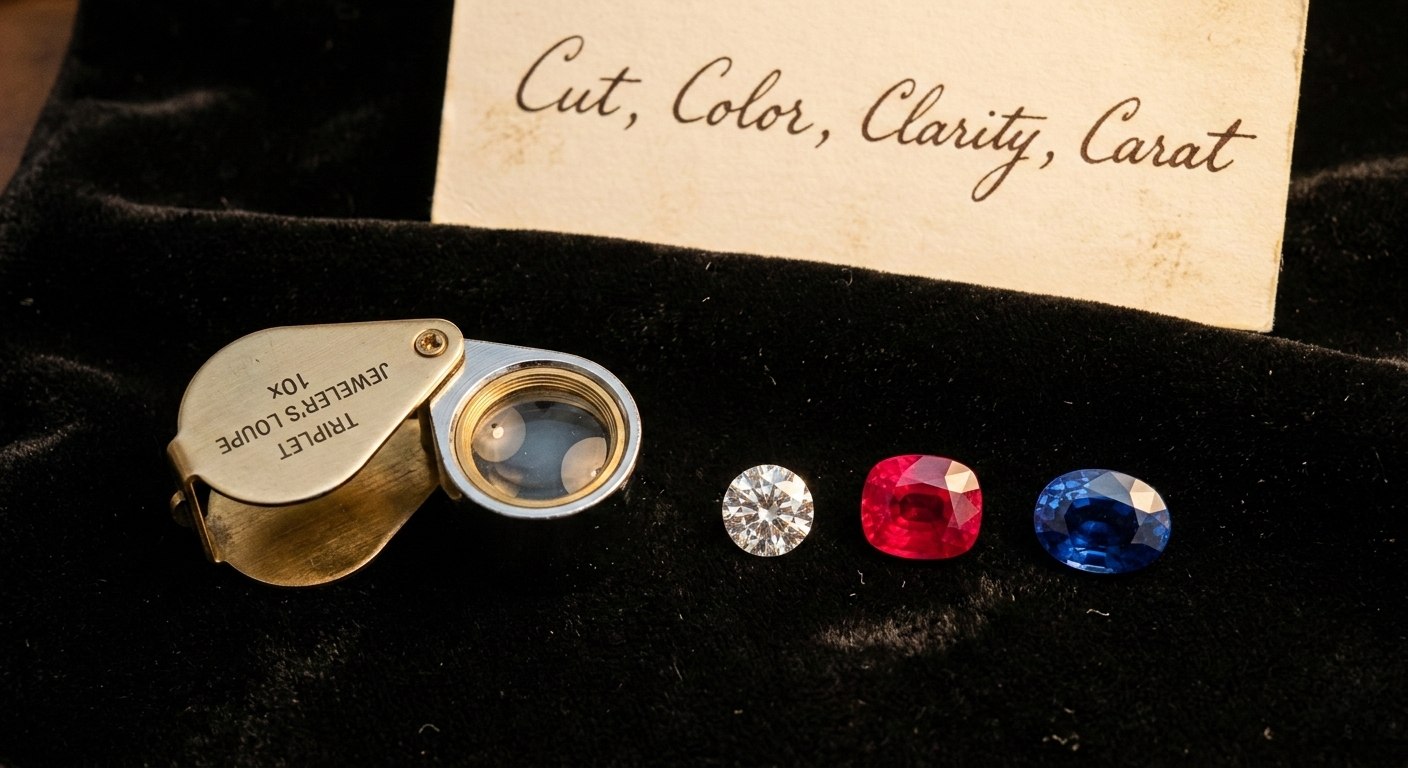
Gemstone value is determined by what the industry calls the Four Cs — a framework originally developed for diamonds but now applied broadly:
- Color — The most important factor for colored stones. Saturation, hue, and tone all matter. The most desirable rubies, for instance, are a vivid ‘pigeon’s blood’ red.
- Clarity — How free the stone is from internal inclusions or external blemishes. Some stones (like emeralds) are expected to have inclusions; others (like aquamarine) are prized for being nearly flawless.
- Cut — How the stone has been shaped and faceted. A well-cut stone maximises brilliance and color; a poor cut can make even a fine stone look dull.
- Carat — The weight of the stone. One carat equals 0.2 grams. Larger stones of the same quality are exponentially rarer — and therefore more expensive.
Beyond the Four Cs, rarity plays a major role. Tanzanite, found only near Mount Kilimanjaro, commands high prices purely because of its limited geographic source. Treatments, certifications, and provenance also significantly affect value.
What Do Gemstone Colors Mean?
The idea that colors carry meaning is one of humanity’s oldest beliefs. Long before color psychology became a science, ancient Egyptians, Greeks, Romans, Indians, and Chinese were assigning symbolic meaning to gemstone hues — using them as talismans, offerings, and tools for healing.
Today, gemstone color meaning sits at the intersection of history, culture, and personal intention. You don’t have to be spiritual to find meaning in a stone’s color — color psychology shows that our emotional and psychological responses to color are real, whether we’re conscious of them or not.
Here’s a quick overview before we dive deep into each color:
- Red — Passion, courage, vitality
- Pink — Love, compassion, self-worth
- Orange — Creativity, warmth, joy
- Yellow — Optimism, abundance, mental clarity
- Green — Growth, healing, renewal
- Blue — Wisdom, loyalty, calm
- Purple — Intuition, spirituality, royalty
- White/Colorless — Purity, clarity, new beginnings
- Black — Protection, grounding, strength
- Multi-color — Transformation, balance, mystery
Gemstones by Color and Meaning
Red Gemstones
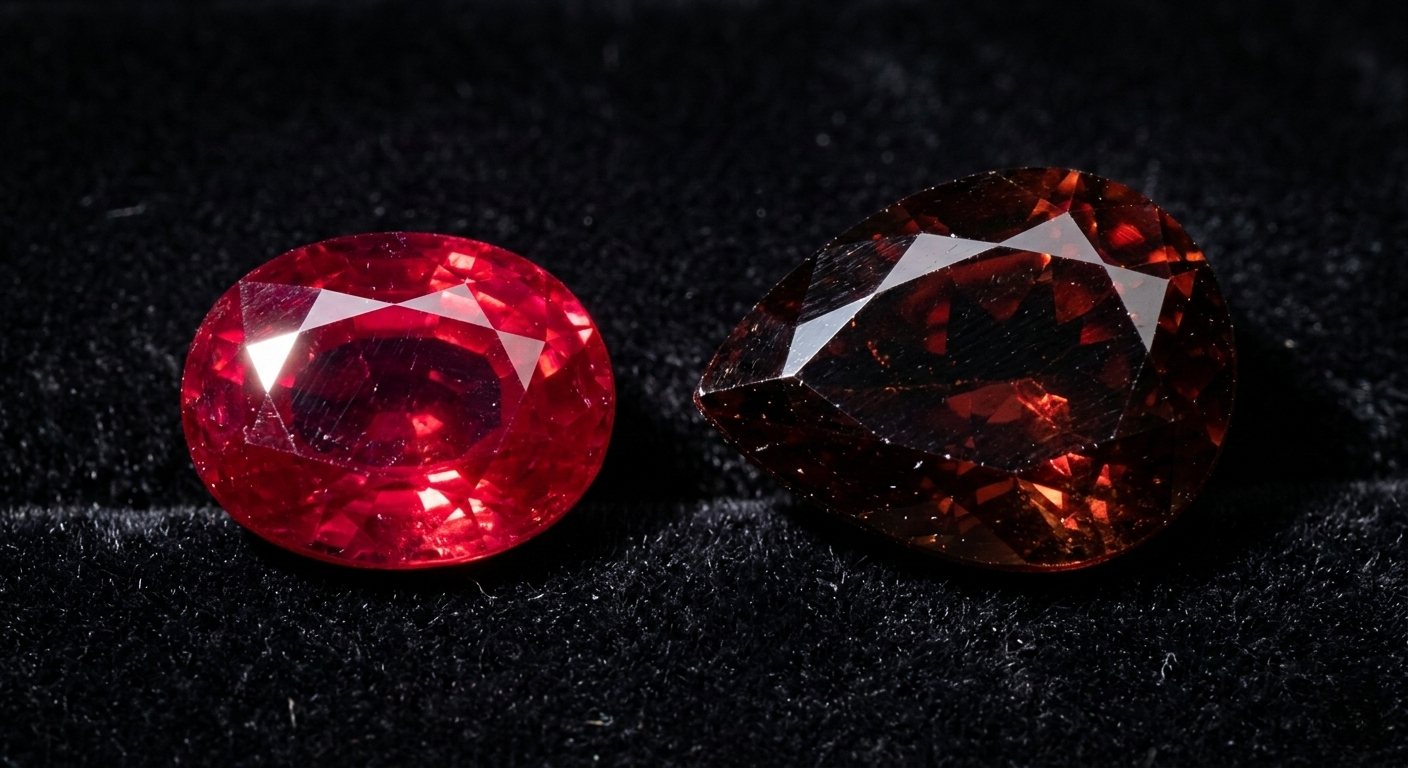
Red gemstones are among the most powerful and historically significant stones in the world. Associated with fire, blood, and the heart, red stones have been worn by warriors going into battle, rulers seeking power, and lovers declaring passion for millennia.
Red symbolizes: passion, courage, vitality, protection, and the life force itself.
Ruby
Ruby is the king of red gemstones — and arguably the most prized colored stone in the world. Its red comes from chromium, and the finest rubies display a vivid, almost fluorescent ‘pigeon’s blood’ red that commands extraordinary prices.
Symbolism: Passion, courage, protection, and nobility. In many ancient cultures, ruby was believed to contain an inextinguishable inner flame. It was worn by warriors for invincibility and by rulers as a symbol of power.
July birthstone. Ideal for: bold gifting, declarations of love, July birthdays, and anyone with an uncompromising spirit.
Garnet
Garnet is often overlooked in favor of ruby, but it’s a remarkable stone in its own right. While most people picture a deep red, garnets actually come in almost every color — with red being the most common and widely known variety.
Symbolism: Devotion, commitment, and regeneration. Garnet is said to kindle love and encourage loyalty in relationships. It’s also associated with travel safety — historically, warriors carried garnets as protective talismans.
January birthstone. Ideal for: New Year gifts, travel companions, and romantic commitments.
Pink Gemstones

Pink gemstones occupy a beautiful middle ground between the intensity of red and the purity of white. They speak of tenderness, romance, and self-compassion — and they’ve surged in popularity as the language of self-love has entered mainstream culture.
Pink symbolizes: love, compassion, romance, grace, and emotional healing.
Rose Quartz
Rose quartz is the most universally recognised pink stone — soft, milky pink, and endlessly versatile. Its gentle hue makes it approachable and calming, which is perhaps why it’s become the go-to stone for self-love and emotional healing in the wellness world.
Symbolism: Unconditional love, self-worth, and emotional openness. Rose quartz is said to open the heart to all forms of love — romantic, familial, and self-directed.
Ideal for: Valentine’s Day, self-care gifts, new mothers, and anyone navigating emotional recovery.
Alexandrite
Alexandrite is one of the rarest and most extraordinary gemstones in the world — best known for its dramatic color-change property. In daylight it appears a bluish green; under incandescent light it shifts to a purplish red. Fine alexandrite is rarer and more expensive than diamond.
Symbolism: Transformation, duality, and good fortune. In Russia, where it was first discovered in the 19th century, alexandrite was considered a stone of good omen. Its ability to change color has made it a symbol of adaptability and balance.
June birthstone (alongside pearl). Ideal for: milestone gifts, anyone who embraces change, and collectors.
Orange Gemstones

Orange is the color of warmth, creativity, and social energy. Orange gemstones are underused in mainstream jewelry, which actually makes them a distinctive choice — they stand out without being aggressive, and they carry a joyful, sun-warmed energy that few other stones match.
Orange symbolizes: creativity, enthusiasm, warmth, and optimism.
Citrine
Citrine ranges from pale yellow to deep amber-orange, and the richer orange varieties are particularly striking. Known as the ‘merchant’s stone,’ citrine has long been associated with prosperity and positive energy.
Symbolism: Abundance, creativity, and confidence. Citrine is said to carry the energy of the sun — warming, energizing, and uplifting. It’s one of the few stones in the crystal world associated with manifesting goals.
November birthstone (alongside topaz). Ideal for: career milestones, creative professionals, and gifts meant to uplift.
Orange Jade
While green jade is more widely known, orange jade carries its own distinct energy. It’s rarer than its green counterpart and prized in East Asian traditions for its warm, vibrant hue.
Symbolism: Joy, sociability, and emotional warmth. Orange jade is said to encourage confidence in social situations and help release inhibitions.
Ideal for: social butterflies, creative gifts, and those seeking more joy and spontaneity.
Yellow Gemstones

Yellow is the color of the mind — associated with intellect, optimism, and clarity. Yellow gemstones tend to be cheerful and energizing, and they pair beautifully with gold settings. They’re often underappreciated, but their brightness and warmth make them instantly mood-lifting.
Yellow symbolizes: mental clarity, optimism, abundance, and happiness.
Yellow Topaz
Yellow topaz ranges from a light golden yellow to a rich, warm amber. It’s one of the most historically significant yellow stones — prized by ancient Egyptians, who believed it carried the power of Ra, the sun god.
Symbolism: Mental focus, wisdom, and confidence. Yellow topaz is said to sharpen the mind and support clear decision-making. It’s associated with abundance and the ability to attract what you desire.
November birthstone (alongside citrine). Ideal for: academic achievements, career gifting, and anyone needing mental clarity.
Yellow Citrine
Lighter yellow citrine differs in feel from its orange counterpart — it’s airier, more optimistic, and less intense. Yellow citrine is one of the most accessible and affordable yellow gemstones, making it a popular choice for everyday jewelry.
Symbolism: Positivity, fresh energy, and mental clarity. The pale yellow of citrine evokes morning light — new beginnings and clear thinking.
Ideal for: everyday wear, spring and summer jewelry, and uplifting gifts.
Green Gemstones
Green is the color of the natural world — growth, renewal, and abundance. Green gemstones have a grounding quality, connecting the wearer to the vitality of nature. They’re also among the most varied color family, ranging from the rich forest green of emerald to the light olive of peridot.
Green symbolizes: growth, renewal, healing, love, fertility, and abundance.
Emerald

Emerald is one of the four precious gemstones and arguably the most iconic green stone in existence. Its deep, saturated green comes from chromium and vanadium, and no synthetic stone has fully replicated the depth and life of a fine natural emerald.
Symbolism: Rebirth, love, and eternal loyalty. In ancient Egypt, emerald was associated with fertility and eternal youth — Cleopatra was famously devoted to emerald jewelry. Historically linked to Venus, the goddess of love, emerald speaks of deep emotional bonds.
May birthstone. Ideal for: romantic gifts, May birthdays, anniversaries, and anyone embracing a new chapter.

Peridot
Peridot is one of the few gemstones that occurs in only one color — green — though the shade varies from a light lime to a deep olive. It’s an ancient stone with a fascinating origin: some peridot is found in meteorites, giving it a literally otherworldly connection.
Symbolism: Positivity, renewal, and protection from negativity. Often called the ‘stone of light,’ peridot is believed to dispel fear, bring joy, and attract abundance. It’s one of the most uplifting stones in the spectrum.
August birthstone. Ideal for: uplifting gifts, August birthdays, and new beginnings.
Aventurine
Green aventurine is a variety of quartz characterized by its glittery, sparkling interior — a phenomenon called aventurescence, caused by tiny reflective inclusions. It’s a stone with a naturally playful quality.
Symbolism: Luck, opportunity, and personal growth. Aventurine is often called the ‘stone of opportunity’ — associated with good fortune in new ventures, whether in business, love, or personal development.
Ideal for: new businesses, new relationships, and gifts for people taking bold leaps.
Jade
Jade is two distinct minerals — nephrite and jadeite — both revered under the same name. In Chinese culture, jade occupies a position similar to gold and diamond in the West: it’s the stone of wisdom, virtue, and immortality.
Symbolism: Wisdom, protection, and harmony. Jade is deeply embedded in East Asian spiritual and cultural traditions. It’s associated with balance, virtue, and longevity. In Mesoamerican cultures, it was more precious than gold.
Ideal for: meaningful milestone gifts, protection talismans, and cultural gifting traditions.
Blue Gemstones

Blue is the most searched gemstone color — and with good reason. Blue speaks to something universal in human psychology: depth, trust, stability, and calm. Blue gemstones are endlessly versatile, working across every metal tone and skin tone, and they carry some of the richest symbolism in the gemstone world.
Blue symbolizes: wisdom, loyalty, calm, honest communication, and divine favor.
Sapphire
Sapphire is the undisputed icon of blue gemstones. While it occurs in almost every color, blue sapphire — especially the velvety cornflower blue of Kashmir stones — is among the most coveted gemstones on earth. It’s second only to diamond in hardness.
Symbolism: Wisdom, loyalty, and truth. Sapphire has been worn by royalty and clergy for centuries as a symbol of divine favor and integrity. It gained worldwide recognition as the stone in Princess Diana’s engagement ring, now worn by Catherine, Princess of Wales.
September birthstone. Ideal for: engagement rings, commitment gifts, September birthdays, and anyone who values honesty and depth.

Aquamarine
Aquamarine’s name literally means ‘water of the sea’ — and its soft, transparent blue-green color makes that name feel exactly right. It’s a stone of extraordinary clarity, often found with very few inclusions.
Symbolism: Courage, clarity, and calm communication. Historically worn by sailors for protection at sea, aquamarine became a symbol of safe passage and courage under pressure. Today it’s prized for its association with clear, honest communication.
March birthstone. Ideal for: brides, March birthdays, gifts for public speakers or communicators, and anyone facing a challenge with courage.
Blue Topaz
Blue topaz doesn’t occur naturally in its vivid blue tones — the striking sky blue and Swiss blue varieties are produced through heat treatment of colorless topaz. Despite this, it’s a genuinely beautiful stone with strong symbolic resonance.
Symbolism: Emotional clarity and honest expression. Blue topaz is associated with the ability to articulate feelings clearly and navigate emotional complexity with grace.
December birthstone (alongside turquoise and tanzanite). Ideal for: thoughtful personal gifts, December birthdays, and deep thinkers.
Lapis Lazuli
Lapis lazuli is one of the oldest gemstones used by humans — worn by Sumerian royalty over 6,000 years ago and ground into pigment for Renaissance paintings. Its deep, opaque midnight blue flecked with golden pyrite is unlike any other stone.
Symbolism: Wisdom, truth, and the search for deeper knowledge. Ancient Egyptians associated lapis lazuli with the night sky and used it in royal burial masks. It’s a stone for those who seek understanding.
Ideal for: intellectuals, teachers, philosophers, and anyone on a journey of self-discovery.
Tanzanite
Tanzanite is one of the rarest gemstones on earth — found only in a small region near Mount Kilimanjaro in Tanzania. It displays a remarkable trichroism: it can appear blue, violet, or burgundy depending on the angle of observation.
Symbolism: Transformation, spiritual elevation, and new perspective. Tanzanite’s rarity and unique visual character make it a stone of distinction — associated with those who see the world differently.
December birthstone. Ideal for: milestone celebrations, unique collectors, and anyone marking a major life transformation.
Purple Gemstones

Purple has always sat at the intersection of power and mystery. In ancient times, purple dye was so rare and expensive that only royalty could afford it — which is why purple became synonymous with sovereignty and spiritual authority. Purple gemstones carry that legacy.
Purple symbolizes: spirituality, intuition, royalty, creativity, and emotional balance.
Amethyst
Amethyst is the quintessential purple stone — rich, warm, and deeply beautiful. Its color ranges from a light lilac to a deep, saturated violet. Historically it was considered a precious stone on par with ruby and emerald; only the discovery of large deposits in Brazil in the 19th century shifted its status.
Symbolism: Calm, intuition, and spiritual clarity. Amethyst has been used in meditation and healing practices for centuries. The ancient Greeks believed it prevented intoxication — the name comes from the Greek amethystos, meaning ‘not drunk.’ Today it’s prized for stress relief, restful sleep, and emotional balance.
February birthstone. Ideal for: empaths, creatives, February birthdays, wellness gifts, and anyone seeking calm in a busy world.
White & Colorless Gemstones

White and colorless stones carry a quiet power. They represent clarity, purity, and new beginnings — a blank canvas onto which any intention can be projected. They’re also the most versatile stones aesthetically, working with every color and metal.
White/colorless symbolizes: purity, clarity, truth, new beginnings, and infinite potential.
Diamond
Diamond needs little introduction. The hardest natural substance on Earth, diamond has been the ultimate symbol of enduring commitment for centuries. Its brilliance comes from its exceptional ability to refract light — a quality that no other stone fully matches.
Symbolism: Eternal love, clarity, and invincibility. The word ‘diamond’ comes from the Greek adamas, meaning ‘unconquerable.’ Beyond romantic love, diamond symbolizes mental clarity and the strength to endure.
April birthstone. Ideal for: engagement rings, significant anniversaries, and landmark achievements.
Pearl
As discussed earlier, pearl is the great organic gemstone — formed not in the earth but inside a living creature. Its lustre is soft and warm rather than brilliant, giving it a distinctive quality that no other stone replicates.
Symbolism: Wisdom, integrity, and inner beauty. Pearl is said to be the result of transformation — an irritant becomes something beautiful through time and layering. It’s a powerful symbol for anyone who has grown through difficulty.
June birthstone (alongside alexandrite). Ideal for: elegant classic gifting, milestone birthdays, and women of any age.
White Opal
White opal displays a captivating play-of-color against a pale, milky background — flashes of red, green, blue, and gold dancing across its surface. It’s the most common variety of precious opal.
Symbolism: Hope, creativity, and spontaneity. Opal’s ever-shifting colors make it a stone of imagination and possibility. It’s said to amplify emotions and bring out the truth in situations.
October birthstone (alongside tourmaline). Ideal for: creative personalities, October birthdays, and those who embrace life’s unpredictability.
Black Gemstones

Black gemstones are among the most underestimated in jewelry. Often associated with sophistication and mystery, they create striking contrasts in silver settings and carry deeply grounding energy. Their symbolism is powerful and protective.
Black symbolizes: protection, grounding, strength, resilience, and elegance.
Onyx
Black onyx is the most widely used black gemstone in jewelry — a smooth, opaque stone with a beautifully even color and excellent polish. It has been used in everything from ancient Roman cameos to modern minimalist rings.
Symbolism: Protection, strength, and self-control. Onyx is said to absorb and transform negative energy — a shield stone for those navigating difficult environments or transitions.
Ideal for: unisex gifts, minimalist jewelry lovers, and anyone seeking grounding and protection.
Black Jade
Black jade is rarer and more striking than its green counterpart, and it carries the same deep cultural significance in East Asian traditions. Its intense, opaque black makes for dramatic, bold jewelry.
Symbolism: Protection, grounding, and inner strength. Black jade is said to protect the wearer from negative external influences while encouraging self-mastery and inner harmony.
Ideal for: meaningful protection gifts and those who prefer bold, statement jewelry.
Multi-Color Gemstones

Some of the most extraordinary gemstones in the world defy a single color category. Multi-color stones are nature at its most inventive — and they carry a symbolism of balance, transformation, and the beauty of complexity.
Opal
Precious opal’s play-of-color is one of nature’s most extraordinary visual phenomena. Tiny spheres of silica within the stone diffract light into shifting spectral colors — no two opals are identical.
Symbolism: Creativity, transformation, and the full spectrum of human emotion. Opal amplifies whatever energy surrounds it — it’s said to be a stone of inspiration and spontaneous insight.
October birthstone. Ideal for: creatives, anyone embracing change, and those who resist being put in a box.
Watermelon Tourmaline
Watermelon tourmaline is exactly what it sounds like: a tourmaline crystal with a pink center and green outer layer, sliced cross-section to reveal the pattern. It’s one of the most visually joyful stones in existence.
Symbolism: Balance, emotional harmony, and joy. The combination of pink (love) and green (growth) makes watermelon tourmaline a stone of emotional balance — equally comfortable giving and receiving love.
October birthstone. Ideal for: lighthearted, joyful gifts and people who appreciate the unusual.
Turquoise
Turquoise is one of the oldest gemstones in human history — found in Egyptian burial sites over 5,000 years old and used extensively in Native American traditions. Its distinctive blue-green, often veined with brown or black matrix, is instantly recognisable.
Symbolism: Protection, wisdom, and friendship. Turquoise has been used as a talisman across virtually every ancient culture. It bridges sky (blue) and earth (green), symbolising the connection between heaven and earth.
December birthstone (alongside tanzanite and blue topaz). Ideal for: protective talismans, meaningful friendship gifts, and boho or southwestern jewelry styles.
Gemstone Meanings by Purpose

Beyond color, many people choose gemstones for a specific intention or purpose. Whether you approach this spiritually or simply appreciate the symbolic resonance, here are the best stones to consider for each intention.
Gemstones for Love
The most powerful love stones work across different dimensions of love — romantic, self-directed, and compassionate.
- Ruby — Passionate romantic love and commitment
- Rose Quartz — Unconditional love and self-compassion
- Emerald — Deep, enduring romantic and familial bonds
- Garnet — Devotion and loyalty in relationships
- Pink Sapphire — Grace and emotional openness in love
Gemstones for Protection
Protective stones are among the most sought-after in both traditional and contemporary crystal work. They’re said to create an energetic shield, absorb negativity, and promote a sense of safety.
- Black Onyx — Absorbs and transforms negative energy
- Turquoise — One of the oldest protective talismans in history
- Garnet — Historically worn by warriors for protection in travel
- Lapis Lazuli — Protective of truth and integrity
- Jade — Long-used in East Asian traditions as a protective amulet
Gemstones for Strength
These stones are associated with courage, resilience, and the inner fortitude to face challenges.
- Ruby — Courage and bold action
- Diamond — Invincibility and clarity of purpose
- Aquamarine — Courage under pressure and clear communication
- Black Jade — Inner strength and self-mastery
- Citrine — Confidence and the power to manifest goals
Gemstones for Anxiety & Calm
Some stones are particularly prized for their calming, grounding qualities — ideal for those dealing with stress, anxiety, or emotional turbulence.
- Amethyst — The most celebrated calming stone; associated with stress relief and restful sleep
- Aquamarine — Calms nerves and supports clear communication
- Blue Topaz — Emotional clarity and reduced anxiety
- Rose Quartz — Soothes emotional wounds and encourages self-compassion
- Peridot — Dispels fear and promotes optimism
Gemstones Once Considered Evil or Negative
Not every gemstone has always been welcomed with open arms. History is full of superstitions around certain stones — and while these beliefs are mostly regarded as folklore today, they make for fascinating reading.
Opal — Despite being a birthstone today, opal had a reputation for bad luck in 19th-century Europe — partly due to Sir Walter Scott’s 1829 novel Anne of Geierstein, in which an opal brought misfortune to its wearer. The diamond trade allegedly spread the rumor to boost diamond sales.
Black Onyx — In some ancient Arabic traditions, onyx was considered a stone of sadness and was believed to cause bad dreams.
Pearl — In some cultures, pearls are associated with tears and therefore considered unlucky as wedding gifts — the idea being that the bride will cry.
These superstitions are largely cultural artifacts rather than universal truths. In most traditions, all three of these stones are considered positive and powerful.
Gemstones by Birth Month

Birthstones are one of the most personal ways to connect with a gemstone. The modern birthstone list was standardised by the American National Association of Jewelers in 1912, though many of the associations trace back far earlier. Wearing your birthstone is considered a form of personal talisman — a stone that aligns with your energy and life path.
January – Garnet
Deep red garnet is a stone of devotion and regeneration — a fitting stone for the start of a new year. It encourages commitment to goals and strengthens bonds with loved ones.
February – Amethyst
Purple amethyst brings calm and clarity to the heart of winter. Associated with intuition and spiritual awareness, it’s a beautiful stone for quiet reflection.
March – Aquamarine
The soft blue of aquamarine mirrors the shifting quality of early spring — calm, fresh, and full of potential. It’s a stone of courage and clear expression.
April – Diamond
Diamond’s association with April speaks to the clarity and vitality of spring’s arrival. As the hardest natural material, it symbolises endurance and lasting love.
May – Emerald
Emerald is spring personified — lush, vibrant, and full of life. May’s birthstone speaks of growth, love, and the renewal that comes with the season.
June – Pearl & Alexandrite
June has two birthstones of remarkable contrast. Pearl, organic and luminous, speaks of wisdom born from transformation. Alexandrite, rare and color-changing, represents the adaptability and duality of mid-year.
July – Ruby
Ruby’s fiery red is perfect for July — the height of summer, full of heat and energy. It’s a stone of passion, courage, and the life force at its peak.
August – Peridot
Peridot’s vibrant green captures the abundance of late summer. It’s a stone of positivity and renewal — a reminder to enjoy what’s flourishing before the season turns.
September – Sapphire
Sapphire’s deep blue brings the clear skies and crisp air of early autumn. It’s a stone of wisdom and loyalty — ideal for the reflective quality of the season.
October – Opal & Tourmaline
October gets two of the most colorful stones in the calendar. Opal’s shifting spectral colors mirror autumn’s transformation, while tourmaline — which comes in virtually every color — celebrates diversity and balance.
November – Topaz & Citrine
November’s warm golden tones are perfectly captured by yellow topaz and citrine — stones of optimism, abundance, and the comforting warmth of late autumn light.
December – Turquoise & Tanzanite
December holds three birthstones: turquoise (ancient and protective), tanzanite (rare and transformative), and blue topaz (calm and clarifying). All three carry a blue energy that mirrors the cool, contemplative quality of winter.
How to Choose a Gemstone That’s Meaningful to You

With so many beautiful stones to choose from, the decision can feel overwhelming. Here are three clear frameworks to help you find the right gemstone — whether you’re buying for yourself or for someone special.
Choosing by Color Meaning
Start with intention. What do you want this stone to represent or remind you of?
- Seeking calm? → Blue or purple stones (sapphire, amethyst, aquamarine)
- Wanting to invite love? → Pink or red stones (rose quartz, ruby, garnet)
- Need grounding or protection? → Black or green stones (onyx, jade, emerald)
- Chasing abundance? → Yellow or orange stones (citrine, topaz)
- Marking a fresh start? → White or colorless stones (diamond, pearl)
Color is the most immediate, instinctive way to connect with a stone. If a color consistently draws your eye, trust that pull.
Choosing by Birthstone
Birthstones turn jewelry into a personal talisman. They make for immediately meaningful gifts — the recipient knows you’ve thought about them specifically, not just chosen something generic. A piece of birthstone jewelry is rarely just decoration; it becomes something the wearer keeps for life.
If you’re buying for someone else and aren’t sure of their birth month, ask — most people are quietly pleased when someone wants to know.
Choosing by Intention or Purpose
Perhaps the most personal approach is to choose by what you need right now. This isn’t about superstition — it’s about giving yourself (or someone you love) a tangible reminder of an intention.
- Going through a difficult transition? → Tanzanite or alexandrite (transformation)
- Starting a new relationship? → Emerald or rose quartz (love and growth)
- Facing a major challenge? → Ruby or diamond (courage and endurance)
- Recovering from loss? → Amethyst or aquamarine (calm and healing)
- Celebrating a major achievement? → Diamond or sapphire (excellence and loyalty)
The right gemstone isn’t necessarily the most expensive or the most famous. It’s the one that means something — to you, or to the person you’re giving it to.


